 Uncategorized
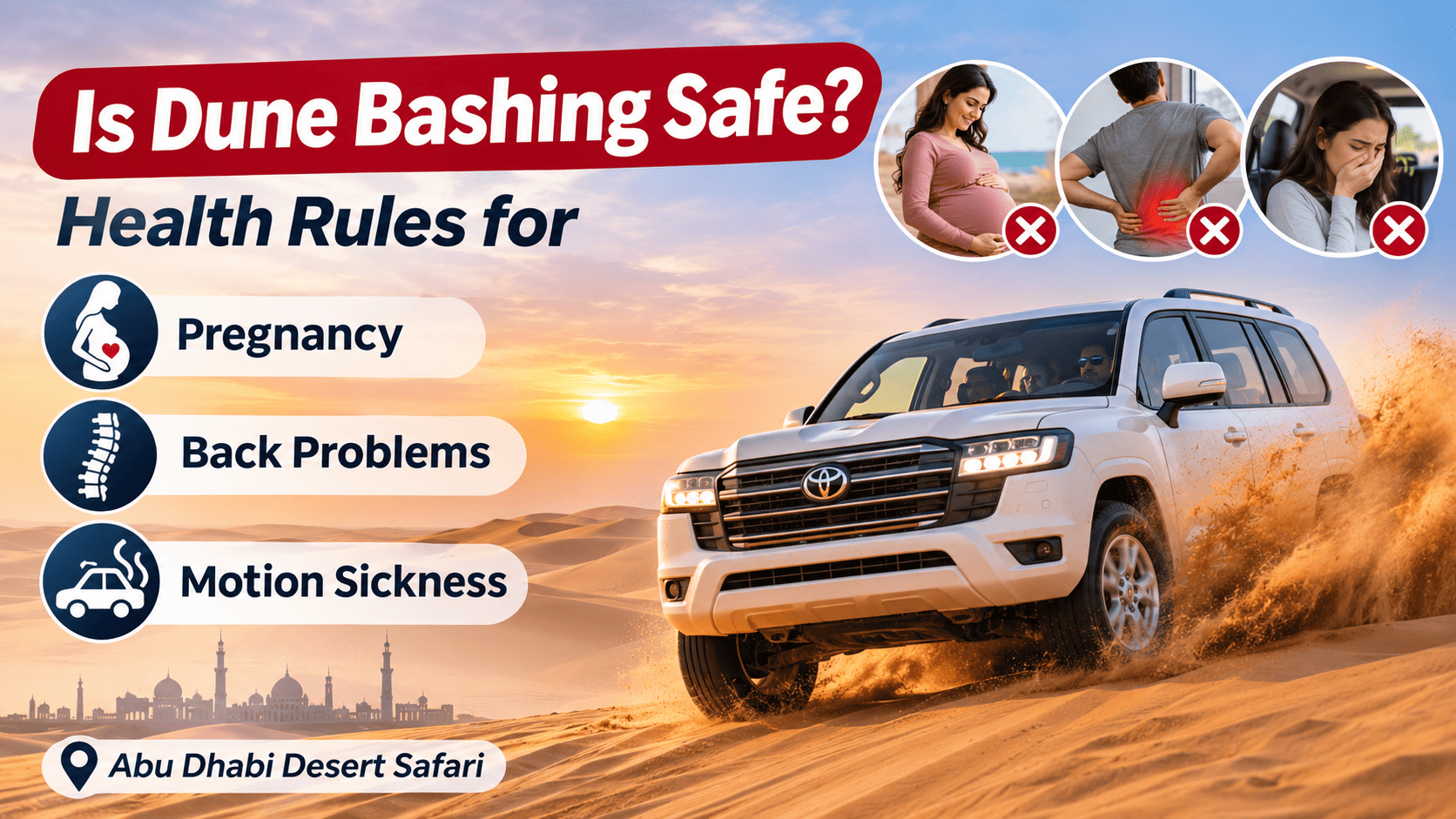
For most healthy adults? Yep. Hop in a well-looked-after 4×4, let a licensed driver do the driving, keep your belt on, and you’re good. It’s a no, though, if you’re pregnant, you’ve just had surgery, or there’s something serious going on with your back, neck or heart. As for feeling queasy, it happens a lot, but it’s usually easy to deal with.
One thing first: we’re giving travel guidance here, not medical advice. If you’ve got a health condition, check with your doctor before booking.
Dune bashing is that fast 4×4 ride up and over the sand dunes, and it comes with most desert safaris. The videos make it look pretty wild, so it’s natural to wonder whether it’s okay for you.
We wrote this for first-timers, families, pregnant travellers, and anyone with a dodgy back or a weak stomach. You’ll find out who can ride, who should skip it, and how you can still have a great desert safari in Abu Dhabi if the dunes aren’t for you. Our rides happen in the Al Khatim desert, a drive out from Abu Dhabi city.
Who should not do dune bashing?
It comes down to your health. Most healthy adults can ride without any trouble. If you’re pregnant, have had surgery recently, or live with a serious back, neck or heart problem, give it a miss. Find your situation in the table below.
| Your situation | Can you do dune bashing? | What to do instead |
| Healthy adult | Yes | Wear your seatbelt the whole time |
| Nervous first-timer | Yes | Ask the driver for a gentle run |
| Pregnant, at any stage | No | Take a smooth transfer to camp |
| Recent surgery | No | Enjoy the camp only, and ask your doctor first |
| Serious back, neck or spine problem | No | Enjoy the camp only |
| Mild back stiffness | Ask your doctor | Gentle run only, if your doctor agrees |
| Heart condition or high blood pressure | Not unless your doctor says yes | Camp only, or a gentle run with your doctor’s okay |
| Easily motion sick | Usually yes | Follow the steps in the motion sickness section |
| Young child | Depends on age | Our minimum age is 10. Ask for a gentle run |
| Older traveller with weak joints or poor balance | Gentle run only | Or skip the dunes and enjoy the camp |
Not sure where you fit? Tell our team when you book, not once you’re at the dunes. The driver can only plan a gentler route if they know ahead of time.
Can you do dune bashing while pregnant?
No. Not early on, not later, not even in those first weeks when you barely feel pregnant. The good news? Most of the desert safari is still yours to enjoy.
Why the ride is a problem in pregnancy
Dune bashing is basically one bump, sharp turn, and sudden drop after another, and every one of them pushes your body into the seatbelt. The UK’s NHS advises pregnant women to wear the lap belt low, under the bump rather than across it. Keeping it there on a bouncing dune ride is hard. The NHS also notes that road accidents are among the most common causes of injury in pregnant women.
What you can still enjoy on a desert safari
Ask for a smooth transfer to the camp. The driver takes a flatter track and goes around the dunes instead of over them.
| Activity | Okay while pregnant? | Note |
| Smooth transfer to camp | Yes, if your doctor says travel is fine | Ask for it when you book |
| Sunset views and photos | Yes | Stay in the shade before sunset |
| Dinner and live shows | Yes | Sit back from the fire show |
| Henna | Usually yes | Ask for natural henna. Skip “black henna” |
| Camel ride | Best to skip | The camel lurches hard when it stands up and sits down |
| Sandboarding | No | Risk of falls |
| Quad bike or dune buggy | No | Same jolts as dune bashing, or worse |
Check with your doctor and your travel insurer
Run your plans past your doctor or midwife before you book, especially if you’re further along. And remember, getting to the desert means a fair stretch in a car. The NHS’s advice for long drives in pregnancy is to stop for regular breaks, and to check your travel insurance actually covers pregnancy care. While you’ve got the policy open, look for an adventure activities exclusion. Plenty of policies have one.
Is dune bashing safe for a bad back?
Got a serious back or neck problem? Then honestly, it’s usually a no. The whole ride is jolt after jolt, and that’s the last thing a sore spine needs. Mild stiffness is a different matter. With your doctor’s okay and a gentle run, you may be fine.
When to skip the dunes
Hurt your back or neck lately? Even if it feels okay again, give the dunes a miss. A slipped or bulging disc? Sciatica? Back or neck surgery in the past few months? All of those count. Osteoporosis or anything else that thins your bones is on the list too, along with back pain that kicks off every time the road gets rough.
Sound like you? Then the camp’s your best bet. You’d still catch the sunset, ride out on a smooth track, and sit down to dinner and the shows like everyone else.
If you only have mild stiffness
Get your doctor’s blessing before anything else. Once they’ve said yes, book a gentle run with fewer steep drops, and ask the driver where the smoothest seat is, because the back row often feels bumpier. On the ride, sit tall with your back and head pressed into the seat, and hang on to the grab handle above the door with one hand. And the minute anything twinges, shout “stop”. The driver will slow right down.
Questions to ask your doctor before you book
- Will my back cope with sudden jolts for about 60 minutes?
- Am I okay sitting in a car for more than an hour each way?
- Is a back support belt a good idea?
- What warning signs mean I should stop the ride?
How do you avoid motion sickness during dune bashing?
Eat light, sit up front, watch the horizon, speak up early. That’s most of it. Of all the complaints on a dune ride, feeling sick comes up most. The upside is that most people perk up again pretty quickly once the 4×4 stops.
Ever wondered why it happens? Your eyes and your inner ear disagree about what your body’s doing, and your brain doesn’t like the mixed messages. Dunes, with all their bumps and swerves, make the disagreement louder. So even if long car journeys never bother you, the sand might.
Before pickup
Before you’re picked up, stick to a small, plain meal. A heavy, oily or spicy one and a bumpy ride really don’t mix. Know you get travel sick? Pop into a pharmacy beforehand. They’ll tell you about tablets, patches and bands, when to take them and which ones work for children. Ginger’s worth a go as well, maybe a cup of ginger tea or a couple of biscuits. Turn up rested and well watered, too.
In the vehicle
Try to sit up front, where the NHS says you’ll feel the least movement. Keep your phone in your pocket and your eyes on the skyline, with the air vent blowing at your face. Feel it creeping up? Say so straight away, and the driver can ease off or find a smoother line. If that doesn’t do the trick, ask them to stop somewhere safe, then step out, close your eyes and take slow breaths with a few sips of water. Drivers see it often, so there’s nothing to be embarrassed about.
Shorter drives help
You can start feeling iffy before you’ve even reached the sand if there’s a long wait and a dozen hotel pickups first. With home pickup or a private car, you cut most of those stops out. Morning and evening safaris are easier on your stomach as well, since the midday heat tends to make nausea worse.
Is dune bashing dangerous? What the ride really involves
Not with a licensed operator and your seatbelt on. Feeling sick is far more common than getting hurt. The risk goes up when the driver isn’t trained, seatbelts get skipped, or someone starts showing off for the camera.
What happens on the ride in Al Khatim
After pickup, it’s roughly 60 minutes out of the city to the dunes at Al Khatim and Al Khaznah. Right where the sand starts, your driver stops and lets a bit of air out of the tyres. Softer tyres grip better on sand.
And then you’re off. Up a dune you go, a little pause at the top, then down the other side in a long slide, with some sharp turns and the odd sideways tilt thrown in. This part lasts about 60 minutes, and then you carry on to the camp. Our desert safari timings and duration page covers the full day, or you can read the complete Abu Dhabi desert safari guide.
Safe signs and risky signs
| Safe sign | Risky sign |
| Every seat has a working seatbelt, and the driver checks it | Seatbelts are missing, broken, or “optional” |
| The 4×4 has rollover protection | No rollover protection you can see |
| Cars drive in a group and stay in touch by radio | One car alone in the open desert |
| The driver asks about health and nerves before starting | No questions, straight to the steepest dunes |
| The driver slows down when you ask | The driver ignores you or speeds up |
Oh, and put your phone on a strap or zip it into a pocket, or it’ll go flying round the car. Our filming tips for the desert explain how to get good shots safely.
Can you do dune bashing in summer?
You can, but take the heat seriously. In July, average daytime highs in the UAE reach about 41 to 44°C, according to the National Center of Meteorology (Gulf News). On top of that, the heat makes motion sickness worse.
So in the summer months, go early in the morning or late in the afternoon. Have water before and after, and wear a hat plus something light and loose. Wind and dust can whip up any time of year as well. A good operator will slow down, cut the ride short or change plans when that happens. Read more about the best time of year for a desert safari.
Kids and older travellers
Most kids and older guests love a desert safari. The dune bashing bit just needs a little thought beforehand.
What is the minimum age for dune bashing?
There’s no single rule. Every operator decides for itself, so check before you hand over any money. Kids under that can still head to camp on a smooth route and have fun with the camels, the sand and the shows.
Does your child use a car seat at home? Mention it when you book. With little ones on board, ask for a gentle run and sit them in the middle row beside you. There are more ideas in our guide to a family desert safari in Abu Dhabi.
Older travellers
Being older isn’t the problem. Health is what matters here. If your joints are weak, your balance isn’t great, or you’ve got a heart condition or brittle bones, choose the gentle run, or just leave the dunes out. Those 4x4s sit quite high off the ground, so feel free to ask the driver to help you in and out.
You can book a desert safari without dune bashing
You can skip the dunes and still have a brilliant evening out there. Just pick one of the calmer options.
| Option | What you skip | What you still get |
| Gentle dune drive | Steep drops and sharp slides | Slow rides over small dunes, sunset photos, the full camp evening |
| Smooth transfer to camp | All dune driving | Sunset, camels, dinner, shows, henna |
| Camp only | The 4×4 desert drive | Dinner under the stars, live shows, Arabic coffee and dates |
Ask for your choice when you book, and get it confirmed in writing. There’s plenty to do at the camp itself. Have a look at our list of activities at the desert camp, or see how to choose the right safari package for your group.
How to check a dune bashing operator is safe
Most of your safety is decided when you book, long before you’re out on the dunes. Pick a licensed company with trained drivers and decent vehicles, and you’ve already done the most important thing for your safety.
Who does the licensing? In Abu Dhabi, it’s the Department of Culture and Tourism, which licenses tourism companies and tour guides (DCT Abu Dhabi circular). Over in Dubai, the Department of Economy and Tourism (DET) licenses safari companies and desert camps, and trains safari drivers too.
Your booking checklist
- The company gives you its legal name and tourism licence number.
- Every seat in the 4×4 has a seatbelt that works.
- The vehicles look clean and cared for, with nothing missing.
- The cars go out in a group, with radios or phones.
- You get asked about health, pregnancy and kids at booking.
- They confirm special requests, like “no dune bashing”, in writing.
- Your travel insurance covers adventure activities.
Red flags
- A super cheap “deal”, cash only, with no company name
- No seatbelts, or a driver who tells you not to bother wearing one
- Being pushed to ride after you’ve said you want to skip the dunes
- No safety talk before the ride starts
Coming from Dubai or Sharjah? Plan for the longer drive
Staying in Dubai or Sharjah? Then you’re looking at roughly 1.5 to 2 hours on the road to Al Khatim, a good while longer than from Abu Dhabi. That much sitting can tire you out, and it raises the odds of motion sickness, so it pays to prep a little:
- Have a light snack before pickup, not a big meal.
- Sit in the front on the highway and look out of the front window.
- Drink water on the way.
- If you’re pregnant, ask your doctor about the long car trip first. The NHS advises regular stops on long journeys.
You might have heard of deserts closer to you, like Lahbab and Al Badayer (“Big Red”) near Dubai, or Al Faya and Mleiha in Sharjah. The safety rules in this guide apply in every UAE desert. Can’t decide which to pick? Our Abu Dhabi vs Dubai desert safari comparison can help. If you’d like to drive a buggy yourself, check out our dune buggy spots in Dubai. Self-drive buggies and quad bikes come with their own age and safety rules.
Thinking about the Empty Quarter? The dunes at Liwa are much taller and the drive is much longer. Our Liwa desert safari guide explains what to expect.
After the ride: what’s normal and when to get help
A bit wobbly or queasy once you’re off the dunes? Totally normal, and it won’t last long. A few things aren’t normal, though, and those need a doctor.
| Usually normal | Get medical help |
| Mild nausea that fades once you stop | Back or neck pain that is strong or getting worse |
| A slightly stiff neck the next day | Numbness, tingling or weakness in your arms or legs |
| Feeling tired after a long day out | A hit to the head, then confusion, drowsiness or repeated vomiting |
| Sand in your hair, shoes and pockets | Bleeding, cramps or belly pain during pregnancy |
Something not right? Let your driver know immediately. And in an emergency, wherever you are in the UAE, the numbers are 998 for an ambulance and 999 for the police.
Frequently asked questions
Is dune bashing safe for first-timers?
Yes, and you don’t need to know a thing about off-roading, because you’re just along for the ride. The trained driver handles everything. Book with a licensed operator, wear your seatbelt from start to finish, and if you’re a bit nervous, ask for a gentler run.
Can I still go on a safari while pregnant?
In most cases you can enjoy the camp, the food and the shows. Leave out dune bashing, quad bikes, buggies and sandboarding, though, at any stage of pregnancy. We can arrange a smooth transfer to camp, and it’s wise to get the go-ahead from your doctor or midwife before booking.
How long is the dune bashing part?
With us, about an hour of actual dune driving. The rest of the evening is the sunset, the camp activities and dinner.
Is there a safari without the dune bashing?
Yes. Just tell us when you book that you’d like a gentle dune drive or a smooth transfer to camp instead. Sunset, camels, dinner and the live shows are all still included. Ask for it in writing so everyone’s on the same page.
Do I need travel insurance?
It’s sensible. A lot of insurers treat dune bashing as an adventure activity, and some exclude it altogether. Pregnant travellers should also make sure pregnancy care is covered. Read the fine print before you go.

